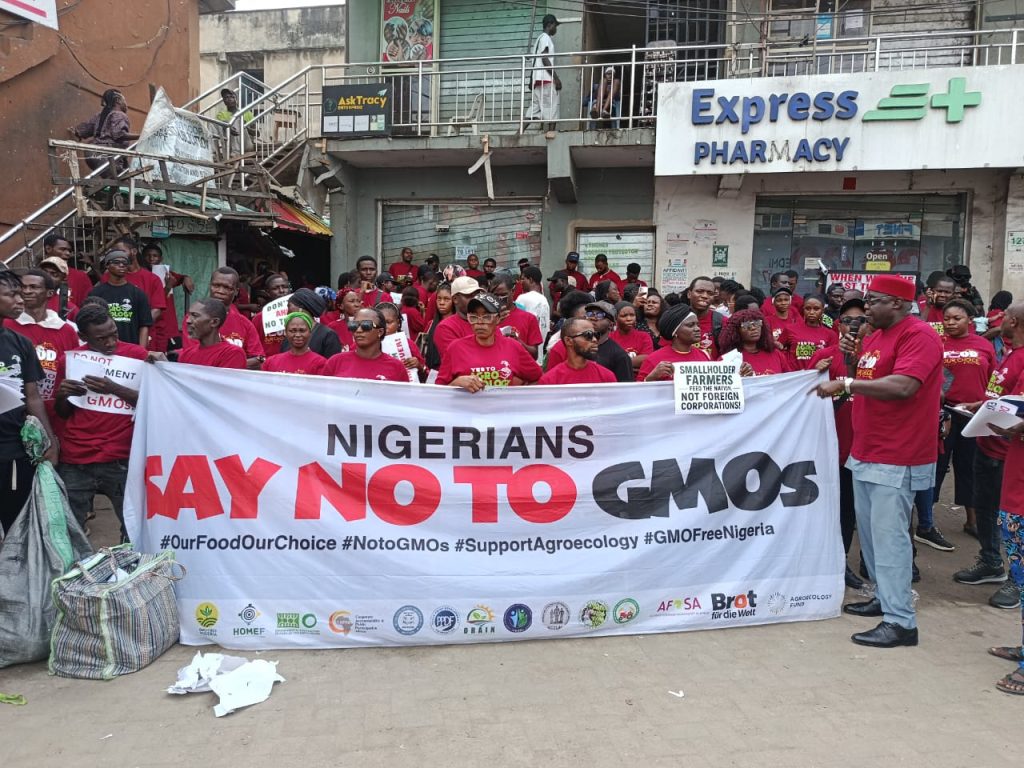
Environmental and public health advocates have urged the Lagos State House of Assembly to ban genetically modified organisms (GMOs) and promote agroecology.
The advocates made the call during an advocacy rally on Friday in Lagos.
The rally began at Computer Village, Ikeja, and ended at the Lagos State House of Assembly, Alausa.
According to the News Agency of Nigeria (NAN), the rally was organised by the Health of Mother Earth Foundation (HOMEF).
The campaign was tagged: “GMOs Will Not Address Nigeria’s Food Crises.”
Speaking at the rally, Mr Olamide Ogunlade of Corporate Accountability and Public Participation Africa, part of the OCA consortium, said the campaign sought public awareness and government action.
He said the campaign aimed to draw attention to concerns about the growing influence of corporate actors in Nigeria’s food system.
He urged the government to prioritise organic farming and agroecology, warning that excessive use of synthetic agricultural inputs could harm the environment.
Ogunlade said the rally had two major objectives: sensitising the public and encouraging dialogue with policymakers on regulating and possibly banning GMOs.
He said Lagos was strategically important because policies adopted by the state could influence national discussions and decisions.
Similarly, Ms Joyce Brown, Director of Programmes at HOMEF, said the campaign sought a ban on GMOs, beginning with Lagos State.
Brown said concerns about GMOs included potential health and environmental effects and the possible loss of control over indigenous seeds and food production.
She said cross-pollination between genetically modified crops and local varieties could contaminate indigenous crops and undermine farmers’ ability to preserve traditional seeds.
She said dependence on commercially supplied seeds could increase farmers’ reliance on corporations for planting materials.
Brown cited Mexico and other countries as examples of jurisdictions that had restricted GMOs, urging Nigeria to protect its food sovereignty.
She also expressed concern about the possible effects of genetically modified crops on soil microorganisms and agricultural productivity.
Brown called for independent, long-term risk assessments to establish the safety of genetically modified crops before further approvals.
She urged the Lagos Assembly to support a ban pending such assessments and introduce policies supporting smallholder farmers practising agroecology.
Brown also called on the Federal Government to follow up on a motion reportedly moved in the House of Representatives in 2024 concerning GMOs.
She said the campaign wanted the government to suspend GMO approvals until independent assessments had been conducted.
A molecular biologist and public health analyst, Dr Casmir Ifeanyi, also urged state lawmakers to take a more active role in regulating genetically modified crops.
Ifeanyi, a member of the Network of African Scientists in Biosafety, Biodiversity and Health, said concerns about GMOs had persisted since the National Biosafety Management Act was passed in 2015.
He alleged that regulatory authorities had continued approving genetically modified crops without adequately addressing concerns raised by critics.
Ifeanyi claimed that more than 16 genetically modified crops had been approved in Nigeria, adding that imported processed foods could contain ingredients derived from such crops.
He questioned whether sufficient baseline studies had been conducted to investigate possible links between genetically modified food consumption and non-communicable diseases.
Ifeanyi also expressed concern about possible effects on biodiversity, soil microorganisms and the nutritional composition of crops.
He identified farmers’ access to seeds and the protection of traditional farming practices as other issues requiring government attention.
According to him, dependence on patented planting materials could undermine farmers’ ability to save and exchange seeds freely.
He urged state assemblies to examine the implications of genetically modified crops for public health, biodiversity and food sovereignty.
NAN reports that the activists, in a petition, urged lawmakers to initiate policies protecting indigenous seeds, supporting smallholder farmers and promoting organic farming.
They also called for stronger support for agroecology and access to information about the seeds and agricultural technologies used by farmers.
The rally formed part of the advocates’ continuing campaign for greater public participation in decisions concerning genetically modified crops and Nigeria’s food system.
(NAN)