By Toyin Falola
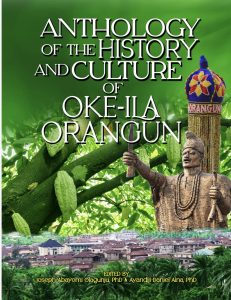
History is not remembered in only one way. A community with history survives through holding onto the traditions it inherited, knowing who its ancestors are, the families and compounds they are from, the stories told by its elders, the institutions that organize communal life, and the rituals, foods, occupations, and performances through which one generation encounters another. It is in this context that the significant work of Joseph Abayomi Olagunju and Ayandiji Daniel Aina, titled the Anthology of the History and Culture of Oke-Ila Orangun, holds significant relevance. It is a book that should be read by all who care to understand the historical context of remembering the roots and the institutions that make it.
This work came to life as an aftermath of discussions that took place at the National Conference on the History and Culture of Oke-Ila Orangun held in May 2022. This volume intelligently brings together numerous sources of history from scholarly essays, oral traditions, genealogies, family histories, cultural practices, among other documented sources.
The book’s significance is distinguished by its strict reliance on conventional local history across various boards. Rather than forcing Oke-Ila’s past into a single chronological narrative, the anthology gathers the many fragments through which a people have remembered and interpreted their identity. Yet, this ambitious act of preservation raises a difficult historical question: when a community gathers its memories and presents them as history, how does one distinguish between what a people remembers about itself and what can be established about its past?
The question becomes particularly important in the treatment of Oke-Ila’s compounds not as mere accounts of family descents, but of their willingness to explore migrations, resettlement, political authority, and the organization of communal life. The compound becomes, in this sense, more than a physical space. It becomes an archive. Names, genealogies, offices, and relationships preserve fragments of a past that may never have entered formal written records. This is one of the anthology’s considerable strengths because it moves the history of Oke-Ila beyond a concentration on rulers and major political events into a community or society through families and institutions that helped sustain it without disregarding genealogical relevance in maintaining social order in the present. An account of ancestry could help establish social belonging, clarify and explain status, and legitimize inherited responsibilities.
This tension gives particular significance to the anthology’s treatment of oral traditions. Oral renditions are indispensable elements in reconstructing African pasts. They challenge written assumptions long ignored or inadequately preserved in the archives. As a matter of fact, it cannot be denied that memory is not infallible simply because it has survived through transmission across generations. Time has proven that traditions can be modified, emphasized, forgotten, or given new interpretations as circumstances change.
The anthology recognizes this difficulty in its discussion of invented traditions and the processes through which traditions become accepted. This gives the work an important degree of historiographical self-awareness. The task is not simply to believe tradition or reject it, but to examine how tradition acquires authority. The more difficult question is whether this caution is applied consistently across the historical materials assembled in the volume. Acknowledging that traditions can be constructed is different from demonstrating how particular traditions have been tested against competing memories and other forms of evidence. It is in this space between preservation and verification that some of the anthology’s most significant historical questions emerge.
The same concern becomes visible when the book turns to culture. Drumming, festivals, ritual practices and traditional institutions are presented not as decorative remnants of an older society but as repositories of historical knowledge. The discussion of the Elemona tradition, for instance, demonstrates how performance can transmit genealogy, authority and communal memory outside formal historical records. Palm wine provides another revealing example. What appears to be an ordinary feature of local life opens into questions of agriculture, trade, household economy, gender, medicine and social interaction.
These discussions expand the meaning of historical evidence. Everyday can be historical: a song can preserve genealogy, a festival can preserve political memory, an occupation can reveal an economic structure, and a food practice can disclose relationships between agriculture, health and identity. In bringing such materials into the historical record, the anthology broadens what deserves to be remembered.
Its attention to education, indigenous food and contemporary development further shows that the editors do not treat culture as a frozen inheritance. Oke-Ila is presented as a community negotiating between what it has inherited and what changing circumstances require. Western education, Christianity, urbanization and economic transformation have altered aspects of indigenous life, while education itself has become part of the community’s response to modern challenges. The volume therefore avoids being merely an exercise in nostalgia. Its concern is not simply that old practices are disappearing, but that when practices disappear without documentation, communities may also lose the knowledge through which they understood those practices. Preservation, then, is not necessarily a desire to return to the past; it can be an attempt to retain enough of the past to understand the present.
Still, the anthology would have been stronger with a more sustained engagement with the differences contained within the idea of “Oke-Ila culture.” Communities do not remember uniformly. Different compounds are more likely to preserve different versions of the same past. This variation may be responsible for how younger generations inherit traditions without an understanding of the original meanings attached. Equally possible in this context are the impacts of religious and social institutions that may also produce competing attitudes towards certain indigenous practices. These variations, as much as they exist, are equally strong elements in telling the history of a community. They should not be erased from history. They are themselves historical evidence. A stronger editorial engagement with these divergences would have shown not only what Oke-Ila remembers, but where its memories intersect, diverge, and acquire authority.
The anthology’s vastness creates another methodological challenge in integrating modern scholarly interpretations alongside oral accounts, indigenous compound histories, cultural descriptions, as well as visual materials. These interplays affect the evidentiary status of its contributions, as submission becomes uneven. A better approach would be to employ a consolidated chronology that brings together a more systematic genealogy that allows a clearer distinction between oral testimony, community tradition, archival evidence, and scholarly interpretation. This approach would make any historical argument easier to navigate. It would neither diminish indigenous knowledge nor add unnecessary credibility to modern interpretation. Rather, it would ensure transparency between memory and historical interpretation.
The use of visual displays further complements this work by recording landscapes, landmarks, cultural practices, objects, foods, and historical sites that would have been merely illustrative through prose alone. They remind the reader that history is attached to physical things, as much as to written accounts and spoken narratives. Places change, buildings disappear, practices decline, and objects lose their everyday relevance. To document them is therefore to keep records that can be transmitted even when the elements have changed forms.
What ultimately makes the Anthology of the History and Culture of Oke-Ila Orangun valuable is the subtle discomfort between remembering and knowing. It gathers long-lost and forgotten materials across different times while raising questions about how these memories can be included in history. The book’s greatest contribution, empathetically, is not that it could settle every question about Oke-Ila’s past, but that it could bring genealogies, compounds, institutions, rituals, occupations, food, education, landscapes, and oral traditions into the same historical conversation.
This volume reminds us that a community’s past does not need to stay in a single archive, most especially as it has been proven here that historical knowledge can survive in different forms often overlooked by conventional historiography. As a passing note, this volume also leaves us to ponder the more difficult task of asking what part of history is remembered, who remembers, what part of history is allowed to be forgotten, and most especially, how particular memories acquire the authority to become a people’s history.