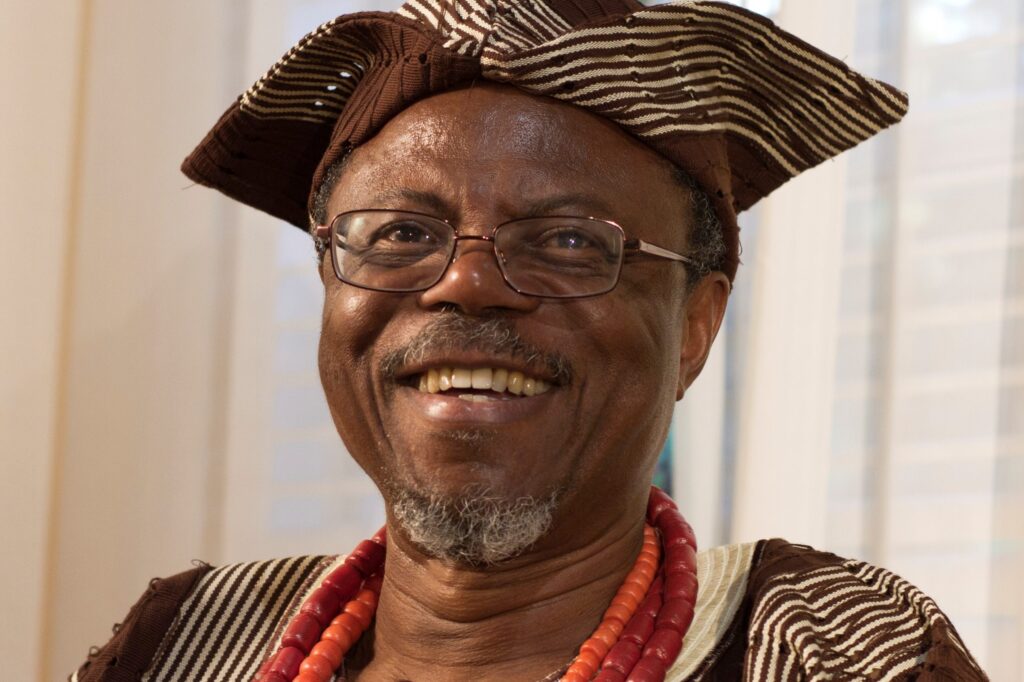
By Toyin Falola
When the Fire Has Eaten the Firewood
I am tired.
Not the tiredness
that sleep can negotiate,
not the small fatigue
that morning coffee can bribe away.
I am tired
like an old road
that has carried too many feet
and received no thanks.
My spirit has become
a village after harmattan—
dust on the rooftops,
dust inside the throat,
dust even upon the gods.
Once,
I was firewood.
I gave myself freely
to every hungry flame.
I warmed houses
whose owners never asked
whether the wood itself was cold.
I became fire
for other people’s winters.
They came with their darkness
and said:
Burn for us.
They came with their hunger
and said:
Feed us.
They came with their dreams
and said:
Carry them.
And because my ancestors taught me
that a river does not drink its own water,
that a tree does not eat its own fruit,
I kept giving.
Until generosity became injury.
Until duty became disease.
Until the drum inside my chest
forgot the rhythm of celebration
and learned only
the slow music of survival.
Now the firewood is finished.
Do not ask the ashes
to produce another flame.
Do not accuse the river
because drought has entered its mouth.
Even the baobab,
that ancient witness,
must sometimes stand silently
beneath a merciless sun.
Even the lion sleeps.
Even Ṣàngó must put down
his thunderstones.
Even Ogun must leave the forge
and allow the iron to cool.
So tonight
I return my burdens
to the earth.
Let the earth carry
what my shoulders cannot.
Let the ancestors sit beside me
without demanding wisdom.
Let nobody ask me
to be strong.
Strength has eaten enough of me.
I want the holiness
of doing nothing.
I want to sit beneath a tree
and become nobody’s answer.
I want my name
to disappear temporarily
from the mouth of obligation.
If the world collapses
because I rested,
then perhaps
I was carrying
too much of the world.
Tomorrow may come
with another drum.
Tomorrow the rain
may remember my roof.
Tomorrow some stubborn green thing
may push its head
through the burnt earth.
But today—
let me be ash.
Ash is not failure.
Ash is evidence
that something burned
for a very long time.
And sometimes
what looks like an ending
is the earth quietly preparing
a place
for fire
to become life again.
I am writing this piece tired, but like the Nigerian youth, I say, “we move.” Society builds expectation blocks and obstacles we must tackle, not sometimes by our own designs, but by the very foundation of the community we find ourselves in. Respect, relevance, and reverence are always measured on the calculus of work and engagement. If you are getting married, your in-laws will probably ask you what work you do. So, society classifies your importance by the values they understand are attributable to your work. Hence, you cannot lose it. Instead of calling yourself a taxi driver, better say you are a land pilot! If you work to fix braids, put PhD after your name, and when challenged, you can say that it is Professional Hair Dresser (PhD)
But when we all get to have the work, we are left alone with our minds battling the schedules, which are often not made easy by the terrains of environments like Lagos. But you must show up, not only because you could lose that job but, more importantly, because you will look unserious. So, you must plug in; you do it hard, no matter what it costs.
Gone are those days when people determined their work hours. Our parents worked within the period their limits could take. Those who were in the early days of corporate jobs did not really need to get home at 11 pm at night. They did not have CCTV at work monitoring them. Back then, just working was enough, and hard work was the extra. These days, the latter is the former.
I understand that the current dispensation has its share of lazy people, but the job engagements are so rigid that they forget the humanity behind “human resources,” so the idea of “work-life balance” becomes a concern, and therapists become the speed dial of many 9-5ers. Working is when you do the work without ceasing, no matter if what you get from it is substantial or not, and hard work is what the capitalist sees as hard work, even if you kill yourself.
But to feed yourself and to not lose social relevance, you must work. It does not matter if it fits your passion; it does not matter if you do not feel up to it or are emotionally not in tune; you must do the job, and you must do it carefully.
So, imagine living in Ikorodu and working in Lekki, Lagos, or whatever comparable distance, and you must face the unending traffic with the annoying frustrations from other commuters or bus drivers. Imagine you do not even have the time to rest at work, and you also have an HR who micromanages you like your village people. You obviously need a pause, but you cannot because that would mean you are lazy. You need to rest at work or take your mind off work for a minute, but that is impossible.
Employers develop Key Performance Indicators (KPI) that serve as parameters to quantify work done. They also have personal daily work assessment logs that show whether you completed the daily task. But they do not have parameters for burnout. Your problems are in layers.
You see, burnout is different from random stress; it is the pinnacle of stress, the peak at which the accumulated stress pushes you. It’s not mere tiredness; it is losing your grasp of situations and the finality of dialing out of your interest in work. It is the tipping and burning point where you lose yourself.
We often do not talk enough about this situation. Employers are not concerned as long as you meet your KPI and the income is steady or increases. But about 76% of employees worldwide get to that point of burnout at least once. This is a real problem; it is both an issue for the business and the individuals.
The first issue is meeting deadlines. You are often left with more than one task. Probably why you are asked if you can multitask during interviews: you must meet the deadlines for each task and meet the outstanding expectations. Sometimes those timelines overlap, and many are equally important, so you cannot prioritize one over the other. The best thing you can do is to face them head-on, and by the time you are done with the pressing one, the turnaround time for the others will already be close. The circle continues day after day.
Doing this every day, every week, and every month compounds your issues. Unfortunately, you do not have enough time to rest either during the week or at weekends. If you work for someone, you most likely would resume between 8 am-8:30am and the average official closing hour, especially is around 6 pm. The unfortunate thing is that you most likely will not leave the office at that time because you have deadlines to meet, so you will want to stay a little longer. When you close, you join the long traffic and get home around 9 pm or later. Before you eat and refresh, the day is gone, and you will only get to catch some sleep before you continue the circle the next day. If you think the weekend will make things better, it is a lie. Weekends are “view once”: Saturday is often used to catch up on work left undone that week or some other things you could not do during the week. You do not have friends, and if you do, you seldom get to interact with them. I mean, they’re busy too.
Burnout is a problem of the system, and many of these systems are wanting. An average workplace has an hour-long break for workers, but workers seldom take those breaks, and no one cares about it. Leaves are now exchanged for payment in lieu, and for a struggling employee, that is just a better option. If you get to take the leave, you most likely will not be able to take your eyes off your work tabs. You could be fired if you do not reply to your emails.
With all this, one of the most challenging situations is working with difficult colleagues and superiors. Your work becomes a war zone where your colleagues are terrible. It is even worse when your supervisor, or superior, micromanages and does not give you breathing space. Some employers are also constantly engaged in various unfair labour practices that put employees on edge. No wonder this generation complains so much about mental health; it is not a joke; it is, in fact, a real issue.
The instances are a lot; it is a crescendo from consistent stress to the peak point. I am convinced that burnout is less an individual problem and more a systemic and structural failure of the employment environment and society in general. Employers invest heavily in resources but not in what refreshes their employees. When you buy heavy-duty machines and other equipment, you maintain and service them to keep them in good condition. This approach should be applied to human resources as well. Aside from paying salaries, which are payments for services rendered, the company should also be deliberate in maintaining them.
It is important for employers to conduct regular check-ins with employees, organize team-bonding activities, and create environments that promote relaxation. There are a limited number of workplaces that have relaxation centers, and this is a pivotal provision if you want good productivity.
Employers must now see the need to tackle burnout structurally. Workloads must be managed and shifted across employees. When your employees have too much to do, hire more staff or increase salaries proportionally. The former is always better. It is also important to allow employees to manage their own time by employing more flexible work approaches, like working from home.
More importantly, employees and managers need to be trained on tolerance and respect for colleagues. Managers are important in achieving good working environments; they must be sensitive to their subordinates’ stress levels and ensure balance. Good recognition, reinforcement, clear priorities, communication, fairness, recovery time, and respect for leave are some of the efforts necessary to tackle burnout.
For employees, managing burnout is your primary duty. You need to pay attention to yourself. There must be boundaries around work to separate your relaxation and leave from work. Work will not end, but you can. You must understand that working smart through priorities and deadline negotiations is important, not merely working hard. Take time-outs, take yourself out, look for old friends, and go to places; you cannot “come and die.”
If you are at that point in your life today, know that that is not the end. It is a stage, and you will cross to the other. Jaye e, enjoy your life! Make friends and go out. It is okay to visit the gym, join a community, and do things outside work. When you feel burnout consistently, and your finances cannot take it, it could mean that’s your cue to take a time out. It is a challenge, and this too shall pass.