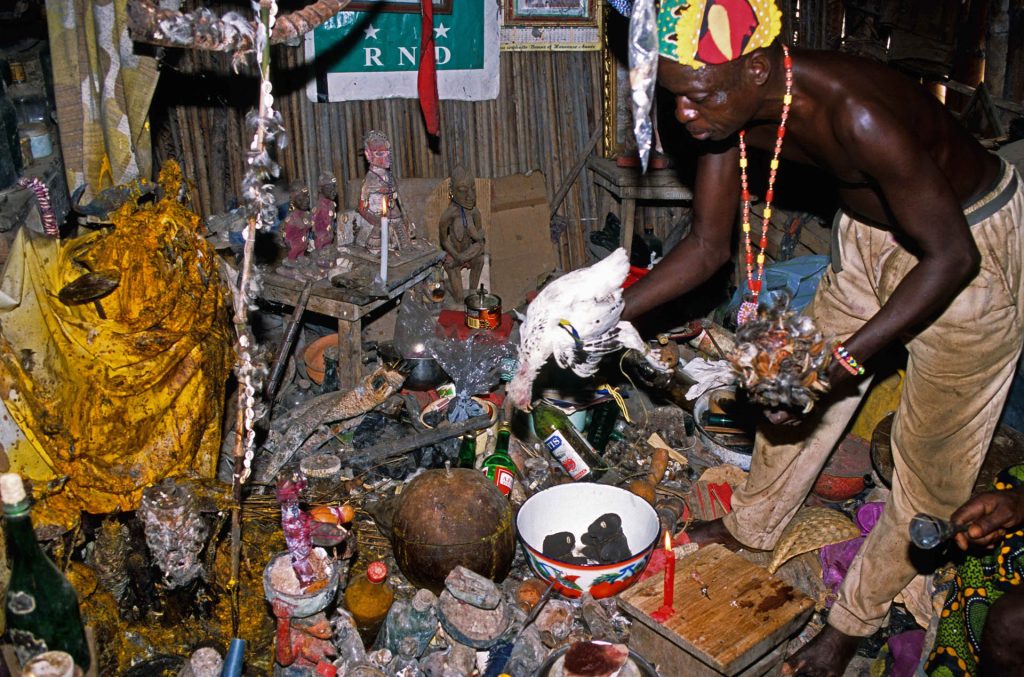
The Toyin Falola Interview’s discussion on witchcraft in Africa has now taken place, and it has left us with a more difficult question than the one with which we began. The pre-interview piece prior to the panel discussion addressed the intellectual question: how should one comprehend witchcraft in relation to African philosophy without simplifying it into the framework of superstition, irrationality, or backwardness? The basic argument is that African societies have created their own interpretation of prosperity and misfortune, of illness and wellbeing, life and death, power and morality, and such an interpretation cannot be dismissed merely because it contains certain realities that cannot be empirically observed. The distinguished members of the panel confirmed the intellectual idea, but took it further as well. Once beliefs about invisible powers are translated into accusations against visible human beings, the question is no longer only what a society believes. It becomes what that belief permits society to do.
This distinction is important because witchcraft has too often been approached as though the central task were to determine whether witches exist. Professor Godwin Sogolo’s intervention offered a useful way out of this familiar argument. Human societies, he reminded us, possess explanatory systems through which they make sense of experience. Scientific explanation asks how something happens: what physical, biological, or mechanical processes produced an event? Witchcraft explanation, in the traditional African context he described, may ask another question: why did this happen to this particular person, at this particular time? The two questions are not necessarily competing. They emerge from different ways of organizing experience. The collapsed structure of a building has physical causes; the question of why it collapsed when particular people were beneath it introduces another dimension of explanation.
This is perhaps one of the most important lessons from the conversation. It asks us to resist the temptation to measure every African explanation of reality against the standards of modern science and then declare one rational and the other irrational. The earlier piece argued that the African intellectual tradition did not always construct an absolute wall between the visible and invisible worlds. The panel strengthened that position. Professor Sogolo was not asking us to replace science with witchcraft. Nor was he asking us to prove the existence of supernatural powers. His argument was more modest and intellectually useful: different systems of explanation may be attempting to answer different questions. But once this distinction has been made, another question immediately follows. What happens when an explanation ceases to be an abstract interpretation of misfortune and becomes an accusation against another human being?
This is where the conversation became considerably more urgent. Dr. Claire Ayelotan shifted the center of the debate from the metaphysical question of invisible power to the social consequences of naming a person as the source of that power. Her intervention introduced a distinction that may ultimately prove more important for contemporary discussions of witchcraft than the question of whether witchcraft itself exists: the distinction between belief and accusation. A person may believe in unseen spiritual forces without identifying another human being as responsible for a particular misfortune. Respect for a religious or cultural worldview does not require society to accept every accusation made in its name. This changes the location of the debate. We can leave the metaphysical question open and still confront the social one. We may never reach an agreement about what exists in the invisible world, but we can reach a moral and legal agreement about what one human being is permitted to do to another. This is perhaps the point at which an intellectual conversation about African cosmology becomes a conversation about citizenship, justice, and human dignity.
The sequence described by Dr. Ayelotan is disturbing precisely because it looks so ordinary. Something painful happens, a family searches for an explanation, and suspicion begins to attach itself to a person. The suspicion is repeated, then a respected voice confirms it. An audience receives it. Eventually, what began as uncertainty acquires the appearance of knowledge. The accusation becomes a story, and the story becomes a verdict. Violence does not necessarily begin with the machete or the fire. It can begin much earlier, when an unverified suspicion is given a name, repeated often enough, and placed within a narrative that makes the accused person appear responsible for somebody else’s suffering. The significance of this sequence extends beyond witchcraft. Human societies have always needed explanations for misfortune. Death demands an explanation. Sudden wealth demands an explanation. Failure demands an explanation. Infertility, illness, poverty, unemployment, family conflict, and unexpected success all create questions that are not always satisfied by a statement of physical causation. Why this person? Why this family? Why now? Why did one person prosper while another remained poor? Why did one business succeed while another collapsed? Why did one woman have children while another did not?
The panel repeatedly returned to these questions. Professor John Azumah’s discussion of northern Ghana showed how accusations can emerge within conditions of economic inequality, competition, changing family relations, unemployment, scarcity, and struggles over social status. A person’s success may become suspicious precisely because others cannot explain it within the circumstances they share. A woman who becomes economically independent may become a target. A widow may become vulnerable because she lacks protection. A family dispute may acquire a spiritual vocabulary. Even drought and poor harvests can become occasions for locating blame in an individual. The accusation, therefore, may tell us less about the supernatural object being accused than about the society making the accusation. This was one of the most productive shifts in the conversation. To ask “Who is the witch?” may be less revealing than asking “Why this person?” and “Why now?” Who benefits from the accusation? Who loses property? Who loses social standing? Who becomes isolated? Whose success has become intolerable? Whose poverty requires an explanation? Whose death has created anger that must be directed somewhere?
Once these questions are asked, witchcraft begins to reveal the architecture of social anxiety. This does not mean that every accusation is secretly about land, inheritance, jealousy or economic competition. The panel was careful enough not to reduce the phenomenon to one explanation. But it does mean that beliefs operate within particular social environments. They acquire force through relationships, institutions, histories and inequalities. Professor Grace Sintim Adasi therefore argued that witchcraft accusations should be studied within the broader contexts of gender, age, poverty, widowhood, family conflict, Christianity, modernity and social change. Gender is particularly revealing. The figure of the witch has frequently been attached to women, especially older, widowed or economically vulnerable women. Their bodies, their age, their voices, their behavior and even their independence can become interpreted through suspicion. The accusation can therefore become another language through which existing inequalities are expressed. It is not necessarily the belief alone that creates vulnerability; it is the social position of the person who becomes available for suspicion.
Professor Azumah pushed this argument further by describing witchcraft accusations as a form of gendered social control in some communities. His observation that women constitute the overwhelming majority of inmates in the witch camps he studied in northern Ghana forces us to consider the relationship between supernatural narratives and structures of power. The “witch,” in such circumstances, is not merely a character in a cosmological system. She becomes a socially vulnerable body upon which fear, resentment, patriarchy and conflict can be projected. Yet there is an additional paradox that the discussion brought sharply into view.

Modernity has not necessarily weakened the language of witchcraft. Indeed, it has sometimes provided it with entirely new worlds in which to flourish. Urbanization, education, technology, migration, economic competition, and globalization have revolutionized African societies; however, uncertainty remains. Sometimes, indeed, they have contributed to its creation. The terminology changes, while uncertainty remains.
Christianity in particular poses a challenge in this regard. While there was no denying of the belief in spiritual power on the part of the Africans by the missionaries, modern Pentecostal and charismatic Christianity provides the theological vocabulary to understand the old African belief in spiritual powers, including concepts such as spiritual warfare, deliverance, demons, curses, and ancestors. Professor Adasi referred to this phenomenon as paradoxical, inasmuch as Christianity denies some traditional practices but believes in invisible powers affecting human affairs. This should make us cautious about any easy story of modernization. The old assumption was that science, education, urbanization and technological advancement would progressively dissolve beliefs in invisible powers. But the conversation suggests that the opposite may sometimes occur. Modernity can produce new forms of uncertainty, inequality and competition, and those conditions can generate new demands for explanation. Witchcraft does not necessarily survive because modernity has failed. It can survive because modernity itself creates experiences that people still struggle to explain morally and socially.
This brings us back to the central question with which this conversation should leave us. The issue is not simply whether Africa believes in witches. Africa is not one intellectual community, and witchcraft is not one uniform category. The earlier discussion already established the difficulty of translating diverse African concepts of hidden power into one English word. What the panel has now demonstrated is that the more consequential question may lie elsewhere. What happens when a society converts uncertainty into accusation? That is the point at which the invisible acquires a visible victim. And once a person has been named, belief acquires consequences. A mother can become an enemy. A child can become a source of danger rather than someone requiring protection. An older woman can become a repository for the frustrations of a community. A successful neighbor can become an object of suspicion. A widow can lose her home. A family can be permanently divided. A reputation can be destroyed even when no physical violence occurs. The accusation can become a social sentence long before it becomes a legal one.
This is where the conversation moves beyond the intellectual history of witchcraft and toward a question that belongs urgently to the present. How do stories acquire authority? How does suspicion become knowledge? Who gives an accusation an audience? Who repeats it? Who legitimizes it? And what institutions are capable of interrupting it before it becomes violence? Those questions take us directly into the world of media. Bear in mind that witchcraft stories have never existed only in the shrine, the household or the village. It has always travelled through stories, performances, religious instruction and popular imagination. But in the contemporary African world, the means of travel have changed dramatically. The television screen, the film, the sermon, the radio program, the YouTube channel, the WhatsApp group and the social-media post can carry an accusation far beyond the community in which it began. The next question, therefore, is no longer simply what Africans believe about witchcraft. It is what the media does with that belief.
PS: (This is the first report on a panel on Witchcraft in Africa, August 30, 2026. For the transcript, see https://www.youtube.com/live/oIDeymUW_o8?si=W3hoi3GWKC9NumJq)