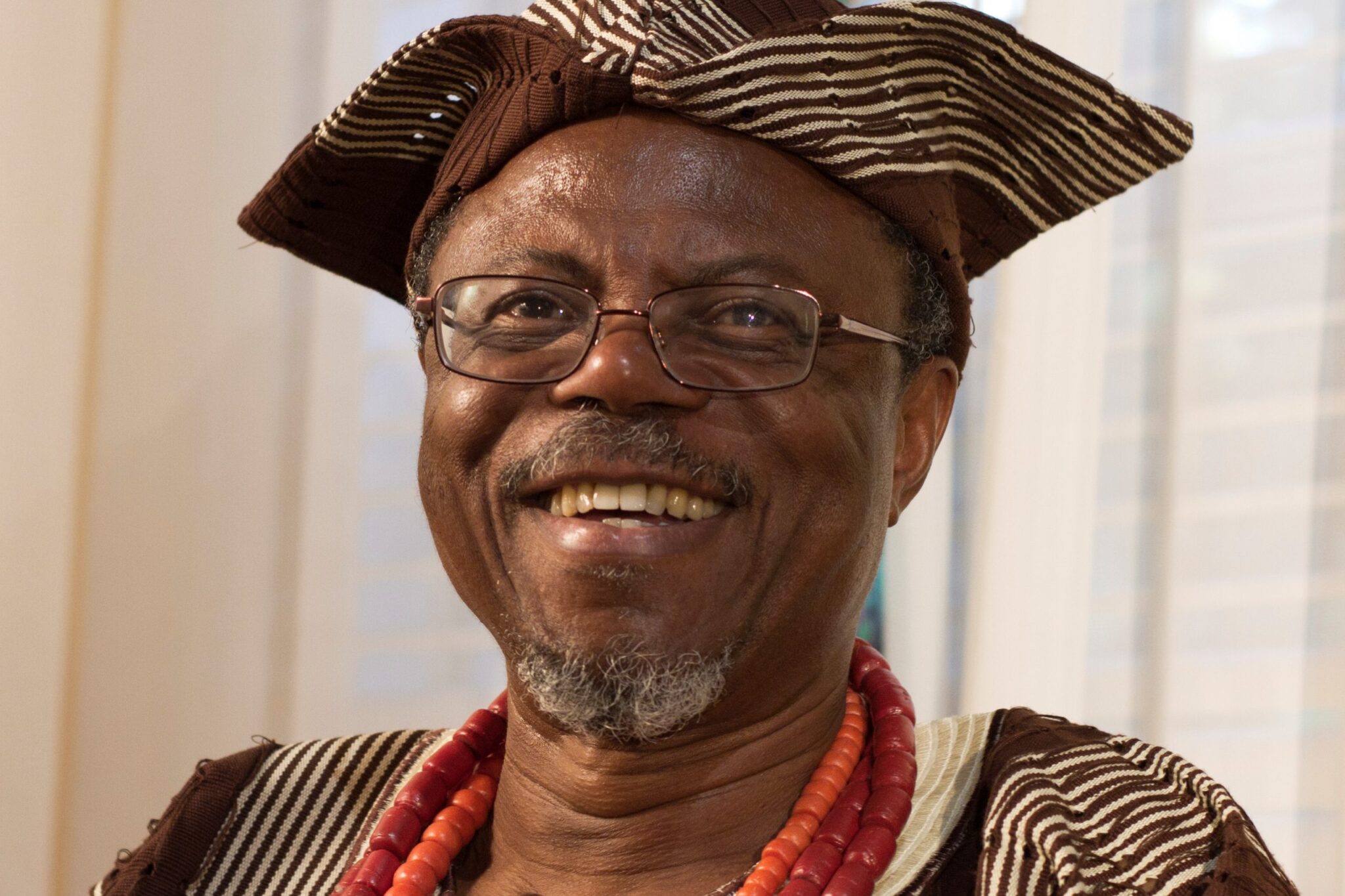
A REVIEW OF TOYIN FALOLA’S RESTLESS PENDANT: ESSAYS ON LASISI OLAGUNJU AND HIS WORKS
By
Michael Ọládẹ̀jọ Afọláyan
I start this review by borrowing the model of the nested linguistic puzzle of Bishop Kukah’s poetically rhetoric (or rhetorically poetic) opening sentence in his Foreword to this seminal work. Honestly, I truly enjoyed that initial statement. To the credit of the much-cherished Bishop, turning a dizzying riddle of referents into a clear pedigree of literary relationships has to be the work of another genius. It afforded me the luxury of raising my own rhetorical question, even if it is not as poetic as that of Bishop Kukah, Here is my question: when the author is a friend, the honoree is a friend, and the publisher is the dream of the reviewer, what else is there for the reviewer to review outside his prior knowledge of those tripartite juggernauts of organic intellection? In a simple, commonsensical way, I stoop to declare that this review is a celebration of friendship, a soft rhythm to the music of many years of camaraderie; and I promise, crossing my heart, that this review will not be the annoying vuvuzela, but a soothing sound akin to the flow of the Osun River in a quiet spring day. It will also double as my tribute to both Falola and Olagunju, as well as my laud for the book’s publishing model, which I will briefly talk about at the end of this review.
First of all, even before delving into the content and contexts of this book, let me confess the intimidating feeling of being honored to review the work of a genius, presented and analyzed by another genius. It is the kind of a message accepted by a messenger who upon being given the assignment must conceal his pounding chest, a fight-or-flight response to an assignment far beyond the cushion of a coping mechanism. But I have to bite the bullet and swallow a bitter pill because by the sheer chord of friendship, necessity compelled me to do the review. Really, it is a profound privilege to be considered for this critical appraisal. The opportunity to engage with a volume celebrating the remarkable contributions of Dr. Lasisi Olagunju, the most acclaimed journalistic writer known to me, by Dr. Toyin Falola, the greatest intellectual and most honored professor of our time in one of America’s Research One institution, is one I must happily accept. Permit me to start by appraising the two scholars interchangeably even before I take a critical look at the work, the real assignment I have been given here.
To be intellectually honest, again, I must admit that my admiration for the author, whom I often refer to as Ọ̀jọ̀gbọ́n Àgbà Toyin Falola (or TF, as he often prefers to be referred to), has no limit. The world-renowned man with the prodigious mind and otherworldly penmanship with cult following is of humble disposition and his writings and the styles he employs reveal such intrinsic characterization. And, what about the laureate himself, the respected festschriftee, Dr. Lasisi Olagunju? The man has always had my unwavering and immutable admiration since getting to know him. Indeed, I refer to him as the Bellator Scripturae (The Warrior of Writing), or a Magister Verbi (Master of the Word) as they referred to great and fearless Graeco-Roman wordsmiths of those days, the likes of Cicero, Virgil, Horace, Homer, etc. My point here is that my respect for Olagunju is simply immeasurable. It is difficult to follow his work and not respect him, and that is the truth.
Falola emits words like the mythical dragon emitting fire, and he does so inexhaustibly and seamlessly. It is no wonder that his friend, Professor Femi Osofisan, always calls him “Iwin” – a ghost who roams its own quantum universe beyond human imagination, a gnomic mythical being with undefinable persona, all of which I consider as perfect pseudonyms for a man who has defied (you could almost say “defiled”) and broken every conceivable rule of normalcy and conventional wisdom in writing and intellection. My late intellectual hero, O. B. Yai, during one of our private conversations, referring to Falola fondly, said, “Abààmì Ẹ̀dá ni ọmọ náà” – (the young man is a strange and undefinable being, admirably weird creature). He further described him as one who belongs in the class of Yoruba folk heroes like Fela, Tai Solarin, etc. Yai was perfectly right. The level of automaticity with which this man writes must blow everyone away. Falola’s inexhaustible pool of work is an empirical manifestation of, and justification for the perceptions of these two men of letters, who are themselves a class of their own, two men of no mean intellectual calibers.
In the same vein, Lasisi Ọlagunju is another mindboggling, phantastic human-being who writes like no man’s business, exploring and executing various themes week after week, with lots of speed, energy, skill, and success, without worrying about what the powers-that-be think about or how they respond to his work. As a writer, Olagunju is a marvel – pure and simple!
Virtually, while Falola engages in the intellectual theater, Olagunju wages his own war on the battlefield of journalism. He is like the modern-day phototyping or cloning together of Dele Giwa, Peter Enahoro (Peter Pan) and Olusegun Osoba combined. Like the 18th century Thomas Paine, the author of Common Sense, Olagunju’s unrivaled penmanship is the invisible power capable of slaying the most mighty generals. For anyone who is a student of systemic text linguistics like me, Lasisi’s writings are a goldmine. The fearlessness in him as epitomized in his confrontational, truth-saying (and soothsaying) columns, in a nation where truth is an enemy, especially to politicians and power brokers, makes him a daredevil with a dauntless personality trait. This is an audacity reserved solely for the rare breed: the intrepid and the visionaries of our society. I consistently keep him in my thoughts and wish him the absolute best in his ongoing journey and work, a crusade not for the faint of heart.
As the first-person protagonist narrator in D. O. Fagunwa’s Ògbójú Ọdẹ Nínú Igbó Irúnmọlẹ̀, himself borrowing a popular Yoruba folk saying, stated to the listeners of his scary tale, “Ìwọ lè jó, èmi lè jó, kòkòrò méjì l’ó pàdé” (You can dance, and I can dance; the challenge is thrown, as two danseur bugs have met in the boundless circle of dance). What I just did here is both a translation and interpretation of that popular saying, helping me to contend here that for Falola to do an exposé of Olagunju’s writings is the right assignment given to the right man, and there is no limit to how far such discourse is capable of taking us. Pẹ́kíi wọ́n ko pẹkí” as the Yoruba are wont of saying, to mean matching the two writers together fits the perfect paradigm of the cliché of “putting the round peg in a round hole.” It is like Àkàrà Oògùn (The human fried cake whose arsenal is full of charms) introducing Kàkó Oníkùmọ̀ Ẹkùn (The hardheaded, obstinate hunter whose hounding wand is the thighbone of the tiger). These borrowed nomenclatural identifications snugly resemble the natures and characters of Toyin Falola, the writer, and Lasisi Olagunju whose massive oeuvre is being partially showcased as a well-deserved festschrift in celebration of a life inundated by many years of uncountable articles and essays in essence of 700 in number plus books of creative writings, and poems, all of sound intellectual qualities.
Like Falola, Olagunju is a workaholic, relentless and restless in his pursuit of excellence in executing his writings and commentaries. Olagunju is also a public intellectual, a trait that the two gentlemen share in common. Seriously speaking, in putting his columns together, Olagunju is a class of his own. His courage is huge and it is no exaggeration to state, categorically, that his style of writing is non-pareil and his way of writing with a clear focus is superbly stunning. It never ceases to baffle my intellectual curiosity as to how he writes so meticulously and ineradicably polished. His construction of sentences and logical arrangement of facts are simply magnificent. Olagunju’s ability to deliver his flow of thoughts is among his strongest strengths. He makes every syllable count, and his sharp mind turns complex terrain of political climates of the nation into a feat so easily navigable. Without a doubt, Olagunju is one of the most beautiful writers it has been my privilege to know in all my life of hanging around writers and thinkers, even in academia. As a close text reader, one always enjoys the simple fact that Olagunju writes with rare economy of the word, turning chaotic syntactic complexity into one clear sentence, and reducing what could have been convoluted and elongated narratives into one simple flow of thought. Indeed, my appraisal of Olagunju has been summed up in the Foreword of Bishop Kokah, when the clergy writes:
“Dr. Olagunju writes with calm and candour, clarity and rare depth. His columns read like great seminar papers as he scavenges the dustbins of history, often pulling out forgotten narratives, folklores, and weaving very beautiful tapestry of Yoruba culture and history. He uses his masterful grasp of world and Nigerian history, Yoruba culture and with a feet-on-the-ground passion, paints a picture of the foibles of the political class while at the same time encouraging Nigeria to keep up the quest for a good society. He could be mistaken for a critic, but deep down, he is driven by a passionate quest for our shared greatness.”
With the above observations of Bishop Kukah, we might as well resign to the old saying, with no pun intended, that “Roma locuta, causa finita” (Rome has spoken, case is closed). The Bishop has provided a Reader’s Digest version of my review in those few words. My review is, therefore, just a coda, an icing on the cake to such beautiful description of Olagunju.
In Restless Pendant: Essays on Lasisi Olagunju and His Works, Falola provides some chapters focusing on the writings of Olagunju, a daunting undertaking that should be critically examined and queried for why those particular themes the author chose to focus on. The titles are: The Reckless Pendant on the Necks of Elites; Gong of the Masses; A Parable of the Noble; Olagunju and Buhari: Marriage of Water and Palm Oil; A Columnist and Nigeria’s Amorphous Problems; Olagunju: Styles and Skills; The Costly Price of Being a Nigerian; The Costly Price a Nation Continually Extorts from Its People; and There is a Place Called Hell: A Treatise on the Making of Worthless Lives. In what follows, I provide a synopsis of each of the chapters.
The first chapter is a celebration of Olagunju’s bravery in challenging the status quo without the fear of a reprisal, intimidation or inherent danger associated with the challenging task of confronting the political elite. In it, Falola problematizes what he calls failure of the elite class or an apparent “systemic elite failure” in mismanaging the country, the plight of the citizens and the confrontational stances of the populace accruing from their lived anguish and trepidations. Here, Falola appraises Olagunju as hope for the hopeless and voice for the voiceless. His objectivity and sagacity in expressing challenging opinions are notable as he deliberately defies autocratic consensus. Like the Biblical Prophet Elijah, Olagunju is the only one capable of challenging the “rulers” (ruthless and acrimonious “Ahabs”) to rule and not to ruin. This is one hat of the truth-saying “prophet” that Olagunju wears, which makes him an unannounced ombudsman for the people and an interlocutor mediating between the unyielding political elite (the “Ahabs” of our time) and the powerless public.
Like the first chapter, the second chapter speaks to the critical role of Olagunju as being more than just a columnist or journalist, but as a town crier, an audacious prophet, the kind that Martin Luther King, Jr described as being “the drum major for righteousness.” At such a difficult time in Nigeria, where citizens are being led dumb “like a sheep being led to its shearer,” the tongue must cease to be docile. After all, critical questioning is a major tool for human freedom. The voice filling the void and breaking the docility of the tongue is that of Olagunju. The goal is to open the eyes of the leadership so as to set the people free. Like Paulo Freire, Olagunju’s work could be perceived as a form of liberation theology because, according to Falola, “People like Olagunju, who voice their displeasure make the most valuable contributions to social development.” Noting, for example, his consistent and persistent warnings against the influx of illegal and unmitigated foreign entities into Nigeria from neighboring countries, and the tendency for imminent future confrontations. This is a warning that has turned out to be prophetic in light of the current social and economic pandemonia that have crept into the fabric of the nation’s framework through its extraordinarily porous boundaries. These and many other social issues are often raised by Dr. Olagunju without any proactive effort on the part of the leadership to correct such matters and they continue to be the bane to the nation’s progress and a string of distress to legitimate citizens of the nation.
In “A Parable of the Noble,” which is the third chapter, Falola opens with an anecdotal argument, a delightful and shrewd pedagogy for making a story to be the precursor to a main message. The message of the anecdote is simple: It’s a totally different thing to identify one’s problem, it’s one step to forging a solution to the identified problem. But the overarching effort lies in its implementability as perceived in the axiomatic contradiction of the mice belling the cat. In other words, the proposed solution here is simply not feasible; it’s a snowball’s chance in hell. The application is that Nigeria and all of Africa have identified their problems, but they have often come up with unimplementable solutions against the invincible political class. To borrow the Yoruba aphorism, “how do you curtail and derobe a priest (in this case, a politician) who is already wearing the bangles made of brass around his wrist?” The cry of Plato is relevant here when he said, “We have an ideal ideology, but where is the ideal man to carry it out?” Falola identifies the ideal man in this chapter as he lauds Olagunju as the man of the season, who is not afraid to tell the emperor that he is naked, and he has done so with seriousness of purpose and the audacity of a lion in the jungle. For this, Falola writes: “I have held Olagunju in high esteem for obvious reasons. For one, his determination to call out politicians to order, irrespective of their heightened political worth, has always won the hearts of people like me because, in such a challenging terrain of discourse, only the determined survive. . . he remains unshaken in how he carves his messages, having seen enough to understand that this trajectory he has chosen needs a significant amount of determination.” No doubt, with these powerful lexes in his arsenal, Olagunju has been able to challenge the seemingly unchallengeables and come out of the boxing ring with no bloodied nose, but clean and unscratched.
In the fourth chapter, titled, “Olagunju and Buhari: Marriage of Water and Palm Oil,” the caption tells the story. Anyone with more than just a casual acquaintance with proverbs in the context of Yoruba rhetorics would quickly understand the meaning of the complementary antonym, or the binary opposition of the employed phrase captured in the caption. Water and palm oil do not interact; they are no friends; they don’t give a damn about each other; they live apart, and in worlds of their own. The truth is, while many would covet the favor of big politicians, Olagunju always takes an exception. He called out the sitting president, President Buhari because of apparent absence of active engagements, accountability, and a demonstration of a lack of seriousness of purpose. Castigating him as a wolf in sheep’s clothing, Olagunju once more, chastised President Buhari for falling short of his promises of objectivity, accountability, discipline and unbiased governance. His attitude to the freedom of the press, which was woeful, did not escape Olagunju’s radar of verbal pounding and relentless bombardments. The scathing diatribe may not necessarily change the anti-progressive policy of the president, but it sure called attention to the fact that there are pundits paying attention to his Machiavellian machinations. It is not surprising, then, that, as Falola observed, “Olagunju’s outspokenness and unwavering honesty have always been the foundation for his enduring popularity among the people. . . this has also garnered him international recognition and acclaim.” For his journalistic integrity and empathic stance for the people, Olagunju has been acknowledged in distinguished fashions.
In the fifth chapter, titled, “A Columnist and Nigeria’s Amorphous Problems,” Falola appraises Olagunju as a critical thinker who insists on raising questions to challenge existing paradigms, and channel the political elite into the right direction in governance. He is able to diagnose and provide the typology of the Nigerian politicians as monolithic, with the same character across the board – a bunch of corrupt and exploitative individuals with penchant for being evil, a cabal of kleptocrats with no regard for the suffering masses. Olagunju’s characterization of the political class cuts across the board, regardless of ethnicity or religious affiliation.
The sixth chapter, titled, “Olagunju: Styles and Skills,” is, I must confess, my own favorite chapter. Someone may ask “why?” My answer is simple: What has personally drawn me closer to paying attention to the writings of Olagunju is his mastery of the use of language. “If one’s daughter is beautiful,” as the Yoruba people often say, “one may as well say it; after all, no one should accuse one of wooing her for an in-house marriage.” As I earlier stated, Olagunju is a mastermind of speech. His ability to use language is unmatched. Falola did not miss this special skill in Olagunju, and had he missed it, one would be justified to ask him the blatant question, “What have you gone to the wilderness to see?” Therefore, it is expected that, as a hypergraphic writer himself, Falola did not miss the styles and skills of Olagunju as among the forces that make people stop and really listen because his words carry so much weight and purpose. Admitting that writing “is a complex level of communication,” Falola hails Olagunju’s unique ability to communicate in writing. Falola is right, Olagunju, in writing, “has masterfully carved for himself an identity that no one can intimidate.” Olagunju’s ability to integrate the Yoruba rhetoric into appropriate approximation as carried over to the English language is undoubtedly meritorious. Citing various examples, Falola underscores Olagunju’s ability to turn rhetorics into effective communication. Yes, “Olagunju is rooted in Yoruba culture and its rich linguistic heritage,” as Falola observes. The use of wise sayings puts Olagunju a shoulder higher than his peers. What Falola calls “native intelligence” in Olagunju is what I call indigenous sagacity, confidence and competence. This is where Olagunju employs his intuitive knowledge and organic erudition to deliver what could have eluded him if he had depended only on the foreign tongue, which is English (it’s the reason I once challenged him to give a paper titled, “Thinking in my mother tongue and writing in foreign words”). The ability on Olagunju’s part to forge an amalgam of Yoruba and English (plus occasional Hausa and Arabic lexes in the mix) often produces an end-product of a beautiful and unimpeachable verbal patterning that no monolingual communicator could so elegantly deliver.
“The Costly Price of Being a Nigerian: A Review of Cowries of Blood: Essays on Herdsmen, Banditry and Nigeria’s Endgame,” is the title given to the seventh chapter. The chapter is a review of Lasisi Olagunju’s 272-page book, Cowries of Blood: Essays on Herdsmen, Banditry and Nigeria’s Endgame Politics. The book is a collection of critical pieces written for his weekly Monday Lines column in the popular Nigerian Tribune between March 2012 and August 2021. Falola’s reading of the book reveals the dilemma of what it takes to be a Nigerian. What Falola is saying here is to underscore the enigmatic paradox entrenched in the exploitative tendencies in the leaders to cheat Nigerians and get away with it. This is what is demonstrated in the fact that while many people are paid for being citizens of their own countries around the world, essentially, Nigerians are made to virtually pay for being Nigerians. The book underscores the plight of a nation bedeviled by despondency, hopelessness, rigidity in the hands of the rulers, compounded by the self-inflicted wounds of ethnicity, religion (as well as, and especially obtuse religiosity), electoral fraud, ethnopolitical nuisances, unprecedented wave of insecurity, and absence of hope or remediation, all of which have paved the way for citizens constantly paying with their own blood. In concluding this chapter dedicated to the review of Olagunju’s Cowries of Blood: Essays on Herdsmen, Banditry and Nigeria’s Endgame Politics, Falola sounds a note of caution that something must be done to avert the looming danger and a impending doom in a continuous demand for the citizen’s blood. “May the citizens not continually pay the costly price of extortion with their blood . . .” he writes. “Olagunju has warned us, not once, but repeatedly. Let us listen.” In other words, Falola is saying here that time is of the essence. It cannot continue this way. We must change our narrative in Nigeria. We must embrace the ethos of inner convictions and readiness to confront the ruling elites. In the words of William Shakespeare in Julius Caesar, “There is a tide in the affairs of men,/Which, taken at the flood, leads on to fortune;/Omitted, all the voyage of their life Is bound in shallows and in miseries./On such a full sea are we now afloat;/And we must take the current when it serves,/Or lose our ventures.” And, as the 23rd century BC Horace taught us in his famous poem Odes and a great battle cry, “carpe diem!” indeed, it is time to sieze the day!
The eighth chapter captioned, “The Costly Price a Nation Continually Extorts from Its People,” is Falola’s further critique and prosecution of the self-inducing pain of Nigeria over Nigerians. Here, Falola continues to hammer on the problematic chair on which Nigerians must sit for ordinarily being Nigerians. Rather than being rewarded for citizenship, Nigerians are being penalized for it. And what do they get in return? They get all the pain and anguish already enumerated in the last chapter.
The very last chapter is titled, “There is a Place Called Hell: A Treatise on the Making of Worthless Lives,” Here, Falola continues with his review of the Cowries of Blood, pointing to “security dysfunctionality,” which has bedeviled the homeland. Worse still, the lackadaisical attitude of the nation’s leadership is indicted to be unparalleled. This is a systemic trend of dereliction of duty across the nation’s governance. Nation-building is a confusing concept between the leaders and the led. Incursive elements like Boko Haram are able to take advantage of the abysmal ignorance of leadership in its failure to understand the plight of citizens, and recognize their right to safety and living a normal, productive life. Olagunju’s Cowries of Blood is a Macedonian Call, beckoning to the leadership the need to understand the needs of the citizens and do something to alleviate their suffering in a nation that promises to be an economic giant and model nation in the Black World at the outset of its independence. The common knowledge that the imperialists’ clever devious stratagem for destroying the nation called Nigeria by skewing power to the North is among the hurts inflicted on the average citizen, even the region of the North is a palpable recipient of such woe.
I would remiss if I fail to acknowledge two things: the first is the intellectual formidability of Dr. Lasisi Olagunju, a fact that is underscored in Dr. Falola’s review of this astounding journalist and avid columnist. Reading Dr. Olagunju’s columns often feels like being back in graduate school, buried under a myriad of scholarly references. He writes like a professor who floods every page with impressive, academic citations, making all his writings appear to me like returning to a graduate seminar where every sentence overflows with scholarly works. My point here is that Olagunju possesses a rare intellectual fluidity, shifting effortlessly from the lofty discourse of classical masters to the vibrant rhythms of neighborhood street slang. Essentially, he is equally as much at home analyzing classical works of Shakespeare as he is confident at decoding local vernacular and writings of D. O. Fagunwa, J.F. Odunjo and even of lesser-known writers. He has cited lines from Ijaala, the poetry of the guild of Yoruba hunters, Ẹkun Iyawo – the Yoruba nuptial chant, and so on. In my mind, Olagunju’s brilliance lies in his complete lack of cultural pretense. His high cultural intelligence is as enviable as it is admirable.
In closing, I would like to make good on my promise to utter a brief statement on the publishers of the book. On my first glance at the book, when I saw that it was published by a local publishing company, Safari Books Ltd., Ibadan, I was elated! It is my dream to see the publishing – academic or popular, of the works of members of the African diaspora at the home base. For all my years of overseas sojourn, one of my sorrows has always been the realization that many of the works of our intellectuals in the diaspora (mine included) have been published by academic publishers overseas, especially in the Americas. The implication is that the books have to be extremely expensive due to the high cost of production. The corollary is that people at home will not have the wherewithal to take ownership of or gain access to such materials. But locally produced works should not be subjected to such highly lamenting fate. We need more books to revive the book culture in which some of us grew up. We need books that are authored by our home-grown writers, who are capable of availing us the indigenous epistemology that lengthened the lives of our ancestors. In the words of George R. R. Martin, the famous American screen writer and author, “A reader lives a thousand lives before he dies… The man who never reads lives only one.” Glorious reputation and loud acclaim, therefore, go to the home-based Safari Books Ltd., Ibadan, as well as to the author who chose the Ibadan-based publishing company.
In all, this work of Falola that focuses on Olagunju is one that deserves to be read intentionally and comprehensively. It is the kind of work that broadens our horizon of knowledge and must, consequently, be tasted, swallowed, chewed on, and digested. It is the least favor the readers of this seminal work must do to themselves.
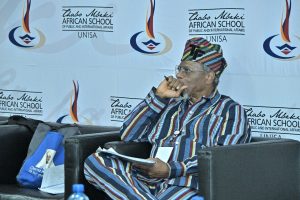
Both Professor Falola and Dr. Olagunju are model scholars, public intellectuals, deep thinkers, and cerebral analysts. Their works speak for them. The two gentlemen, known for their intellectual brilliance, are preoccupied with providing services for the advancement of humanity in their own separate corners, and in their own separate ways. Much of what the two men share in common is their unrepentant flairs for writing, reading voraciously, thinking deeply, and doing so with finesse, plus their unflinching love for the country called Nigeria, our homeland. Falola and Olagunju have cult following. With his virtual and physical presence on campuses, community events, Falola commands hundreds of thousands of followers, from the lowest in the social ladder to the highest in the food chain, including heads of many countries. The same is true of Olagunju with his weekly columns, readers access from all works of life and across the globe. The two gentlemen’s altruistic gestures have earned them a plethora of recognitions nationally and internationally. It should not be too surprising, then, that the current work has brought them together in another intellect-driven service to humanity. To these two men of letters, Fellows of the Nigerian Academy of Letters, juggernaut products of Great Ife, the current reviewer greets you!