The study of History is the beginning of wisdom – Jean Bodin
By Olayinka Oyegbile
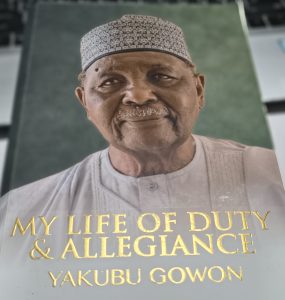
(A review of My Life of Duty & Allegiance, Yakubu Gowon, Havilah Group. Lagos, P859, 2026)
Gen Yakubu Gowon, Nigeria’s former Head of State, whose memoir, My Life of Duty & Allegiance, was presented a few weeks ago, has received mixed reactions even before the copy of the book got into readers hands. Some have reacted based on snippets of news published from selected portions of the book as reported in news stories. It was not unexpected that the book would generate such attention. The elder statesman presided over the affairs of the country at a very crucial and controversial period of the country’s history.
He was called to duty in the immediate aftermath of the January 15, 1966 counter coup and one of Africa’s most reported civil wars (1967-70) as well as the ‘economic boom’ of the 70s. He had held back from writing his memoir for years and now at 92 years, why did he decide to do so? Many asked.
When is the best time to write a memoir?
Some people have faulted Gen Gowon for, in their words, “waiting for most of the dramatis personae in his memoir to die” before writing. They argued that the dead would have no chance to respond to him because dead men don’t tell tales! But who is to blame? If God had not been good to him, would he also have lived so long to write his own side of the story? Well.….
Gen Gowon has no doubt done his own part by writing his own story for posterity to situate his contribution and judge him. My Life of Duty & Allegiance starts with the news of how rumours about his planned ouster by his trusted lieutenants and close pals got to him. He never believed it could be. He also confirms what many have always said about people in power being surrounded or susceptible to influence of marabouts and prayer contractors, who line the corridors of power hoping to have a bite of the pie from the leaders. However, his belief in God never made him fall into their scheming.
From chapter to chapter, using the unique flashback methods, the author chronicles his experience in power from his humble birth, parentage, to his education and commission into the military. He is a man who from his birth seems to have been destined to play a critical role in his country. Detailing his dilly dallying on whether to enlist in the military or not and the critical role he would later play in life is a study in destiny. From when he left the shores of the country for Britain and his return at the nick of time to almost coincide with the coup that ousted the civilian government.
Somehow, he was surprised that his ex-girlfriend whom he had thought his affairs with was over before his departure from Nigeria was on hand to receive him on his return from England despite the fact that there had been a break of communication between them! When events later unfolded, he was suspicious that his old girlfriend who was then a university student in Ibadan might have been brought in by the coup planners to hem him in or keep a tab on him to keep him away from knowing or stopping their action? Was she aware and who informed her of his imminent return to the country? She never told him (p173).
He was also not sure if the then President of Ghana Kwame Nkrumah was in the know of the plot to shuffle Prime Minister Abubakar Tafawa Balewa out of office. However, his conclusion that “poetic justice took its course, as President Nkrumah was ousted from office by his military on February 24, 1966, which was barely a month after the Nigeria coup.” (p181), goes a long way to confirm where he stands. A case of what you sow, you reap?
Gen Gowon has no doubt in this book, given us a rich slice of history of Nigeria from his own lens, readers who are old enough and witnessed some of the events would come across names and incidences that they are familiar with. At least in reading this memoir, I now know that the late Mr Godwin Daboh, who was quite a popular rabble rouser of the 70s and 80s was at one time a Naval rating who was “court-martialed, sentenced and discharged from the Navy” (p231). Nigerians of my age would remember the rambunctious disagreement between the late Daboh and his fellow Tiv man the late Joseph Tarka. “If you Tarka me, I’ll Daboh you!!”
Chapter nine is the one that would interest many readers. It is perhaps the most controversial part of the book because of the issues it covered and the many interpretations that have been given to the subject. Titled ‘Aburi Our Road to Nowhere’. It details what happened in Aburi, Ghana and how it was the last-ditch effort to save the country from plunging into the three-year internecine war. On Aburi we stand became the ‘battle cry’ for the war with Ojukwu claiming that the parties agreed to go their separate ways while the Gowon side insisted it was not what was agreed on. Both sides have up till today held divergent views on what was agreed. It is this that has made Gen Gowon to be in the bad book of some people while others too hold Ojukwu responsible for what happened. The Aburi Accord has as many interpretations as those who claim to have read it!
In the long search to break the cycle of rebellion of the secessionist force, the federal government decided to create states through the creation of 12 states. It was a masterstroke. This is captured in Chapter 10 ‘Time for Action, not for Words’. Reading through this chapter, one could see that the intrigues involved in state creation are not new. The General narrated the behind-the-scenes story of how Ota, in Ogun State was carved along with the state and not part of the old Lagos territory that became Lagos State (P283).
One could also see that the idea of involving university dons in government has been a long-established tradition which Gen Ibrahim Babangida would later emulate and perfect (?). However, what has happened after? Have our eggheads been sucked in into the rot in government so much that they are now ignored? Gen Gowon is full of praises and admiration for Dr Ukpabi Asika and his wife Chinyere who was plucked from the University of Ibadan to be the Administrator of East Central State when it was created from the old Eastern Region. His appointment then was one that was dangerous and delicate for anyone from that part of the country to accept. The General’s account is a testament to a solid belief in one Nigeria that unfortunately is absent across the country today. God bless the soul of Dr. Asika! The old General really paid a glowing tribute to his excellence and performance.
There is no doubt that the memoir is a rich trove of history and character sketches of many military personnel who later played their roles in the affairs of the country. For instance, former President Olusegun Obasanjo and Col Foluso Sotomi he describes as “A typical Lagos ‘Show Boy’ who looked smarter but was more of a big mouth and certainly more bombastic than Obasanjo” (p337).
Chapter 19 which he titles ‘Change of Guards’ documents the prosecution of the civil war under the various commanders of the war divisions. Gen Gowon, is no doubt, a very good judge of characters and brilliant chronicler of persons. According to him, Colonel Murtala Muhammed as a war commander, “behaved unconventionally like a lone ranger.”, while comparing him with other reputed war soldiers, he, however continues, “These capabilities, however, came with a price because he frequently ignored instructions from me and the Army Headquarters.” (p400). On Commander of 1 Division, Col Mohammed Shuwa he writes, “he likes his drinks, he was quite effective and provided me with several decisive victories. Under Shuwa, 1 Division never lost ground.” His troubles with Murtala’s unpredictability and never wanting to subject himself to superior orders came to a head when the late Murtala, “In a fit of anger, he went beyond the bounds of reason or military decorum to send me, his Commander in Chief, an impertinent signal that I should get my fat butt off my chair to sort out things in the battleground instead of giving orders from the comfort of my office in Dodan Barracks.” (p402). It was a classical case military impudence, however, Chief Obafemi Awolowo as vice chairman of the Federal Executive Council, prevailed on Gen Gowon not to act on the spur of the moment in reaction to Col Murtala’s signal. He was spared until the “lone ranger” Colonel abruptly left his command at his own accord!
One thing that comes out clearly from the book is the respect in which Gen Gowon held Chief Obafemi Awolowo. The late sage’s reaction to paying for the weapons purchased without the approval of FEC through the back door, his decision that food sent to the war zone was been hijacked by soldiers and therefore should be stopped are part of the things many hold against the late politician. Gen Gowon, like a true leader whom the buck stops at his table stated all the issues clearly. According to him, the much talked about starvation was more among the civilians because the rebel soldiers were not allowing the food aid to get to the civilians they were meant for.
In Chapter 20, ‘Thank God, it’s all over’ the General writes about the end of hostilities and the steps taken to make sure the country gets back its vitality. In a candid reflection on all the futile efforts made to capture Ojukwu alive during the war, before he left for Ivory Coast “in search of peace”, Gowon wrote, “I always thank God, we did not capture him before or during the war because one cannot be one hundred percent certain what public opinion in the tension-soaked polity could have caused one to do. But I believe that despite all that happened between us, I would have done my utmost best to save his life. God knows. He probably would have been imprisoned for treason between after which he might be pardoned and let off. But to kill him? Never, except in the battlefield where whoever got the first lucky shot survived.” (P450).
He also took the liberty to address one of the issues that dogged the civil war until today. The much talked about Asaba Massacre where able bodied and grown men who had trooped out to welcome the Federal troops were said to have been executed by certain federal officers in cold blood. As the Commander in-Chief at the time, under whose auspices this happened he wrote that it was never brought to his notice and that the erstwhile Super Permanent Secretary Chief Philip Asiodu, who lost his brother in the pogrom and was prominent in his administration never mentioned it to him. He, however, later in Asaba met the then Asagba and apologized for the crime (P464-465).
At least, reading this book has done a great service, in my thoughts, to the country and future generations, the elder statesman did not go into the grave with this memory. How it goes down with others is what one may not be able to predict. But he has put one incontrovertible fact down that under Gen Gowon Nigeria was so rich that “The World Bank came to borrow money from our government to finance industrial development in some developing countries.” (p533). Not today that we go cap in hand to borrow at cut throat interests from the same world body! With what I see as a tone of regret he bemoans the state of our country and its leadership. According to him, “My story, strange and as unbelievable as it sounded in the wake of my removal from office, became a cautionary tale for many of my successors in office. If the way things turned out for me out of office was the gratitude one got for serving with honesty and integrity, none of my successors wanted to suffer my fate.” (P612).
Today, governors and other political office holders retire into fabulous wealth and leave the people poorer than they met them. Gen Gowon has done a great service to the literature of leadership by example. This is a book that should be discounted, especially with the donation got at the presentation, and made available to readers across board. It is a great book and perhaps one of the greatest political memoirs to have come out of this country in recent times.
Reading the Appendix is like going through the Nigerian problems all over again. Issues that have been addressed and listed for solutions in the 70s are still besetting the nation till today! The issue of fuel shortage and its prohibitive cost, the Port Harcourt Refinery not been able to supply enough fuel for domestic consumption, education, unemployment and so on. It’s like we have not moved an inch beyond those issues. In fact, one can safely conclude that we are perhaps worse off today despite us been blessed so bountifully!
The publisher did a great job in putting this book together, the neat printing and binding and clear pictures are very commendable with the size and number of pages. It shows that publishing of quality books could still be done by local publishers. However, there are few hoopla that must be corrected in the reprint. On page 66 it reads, “..even if they resumed on the same day, because they were had stepped on the ground of Barewa College much earlier” (p66). The “were” in between ‘they’ and ‘had’ should be removed. Page 122 refers to the late Gen Abacha as “President Sani Abacha” He was never officially called that. He was Head of State, and on Page 127, “He immediately corrected my gaff… (p127). It should read gaffe not gaff (proofreading error). Also listing the coup casualties of 166, it says, “..Prime Minister, Sir Abubakar Tafawa Balewa, Finance Minister, the Finance Minister, Chief Okotie-Eboh…” (p184) with his office listed twice before his name.
However, these errors are not enough to take away any of the immense knowledge contained in this mammoth living history.