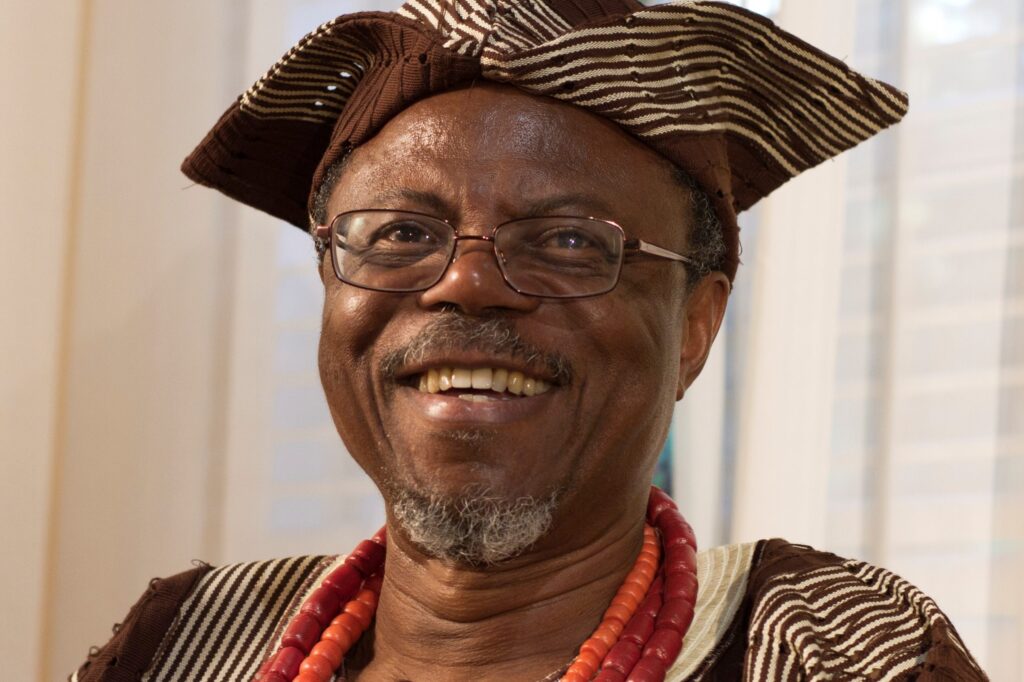
By Toyin Falola
I offer this as my Acceptance Speech on the Conferment of the Degree of Doctor of Philosophy (Honoris Causa) by Ajayi Crowther University, Oyo State. There are times when recognition turns out to be more than an individual’s accomplishment. This is one of those times when recognition turns out to be a meeting with an intellectual tradition, a moral inheritance, and a responsibility which goes beyond the individual who is awarded. Currently, as I accept the honorary degree of Doctor of Philosophy from Ajayi Crowther University, I find myself at one such time in my life.
I accept this award with much gratitude, humility, and a great sense of responsibility. I am thankful to the Pro-Chancellor, the Vice-Chancellor, the learned members of the University Council and Senate, as well as all other members of the university community for considering my contributions worthy of this honor. I am grateful to the Senate for nominating me for the award and the Council for endorsing my nomination. I understand that an honorary degree is not just an ordinary academic credential. An honorary degree is a statement of the institution regarding intellectual and civic contributions and the values that an institution wants to promote.
This act of recognition is rendered even more meaningful by virtue of the institution. Ajayi Crowther University is not just an institution of learning with a renowned name. The university reminds us of the legacy of a great African individual. In its name lies the heritage of Bishop Samuel Ajayi Crowther, an individual whose story of survival through the harshness of enslavement, the opportunities of education, Christianity, and the intellectual discourse of the nineteenth century provides one of the most impressive examples of African achievements. Being recognized by an institution whose name reminds me of such an individual is to recall a history which requires more than just a ritual formality. It is an affirmation of what an African individual can achieve if courage, faith, scholarship, and service are combined.
The story of Samuel Ajayi Crowther begins under conditions which may seem to preclude any chance of attaining what he ended up doing in his life. Raised in the Yoruba-speaking area of modern-day southwestern Nigeria, he witnessed firsthand the brutalities of slave-raiding and kidnapping. His release and subsequent education and religious training marked the beginning of a new path in history, for he would become a learned man, linguist, translator, and a Christian missionary, and ultimately, the first African bishop of the Anglican Communion. What is notable about Crowther’s story is the fact that he managed to rise from being a slave to becoming an ecclesiastical leader. The significance of his story lies in the fact that he made the most of the new possibilities open to him. In other words, he used his knowledge in the service of others, language in the effort to preserve knowledge, and his religion to further the cause of others. His linguistic works involving the Yoruba language and the translation of the Bible into Yoruba should be considered religious activities but also major intellectual contributions to the development of an African language.
This is an essential aspect of Crowther’s legacy. Language is not merely an instrument for communication. It is the medium of memory, of philosophy, of social experience and a tool that enables communities to reflect upon their position in the world. Working on a language involves, to a great extent, working on the intellectual tradition of those who speak it. Crowther knew that the task of disseminating knowledge could only be fulfilled by utilizing the language of the people. This is why his work is not only part of the history of Christianity in Africa but also of the more general history of African scholarship. Crowther’s life forces us to rethink the connection between Africa and knowledge production. For far too long, African intellectual history has been written with the underlying premise that Africa had been a recipient of ideas, institutions, and civilization from other parts of the world. These stories have tended to downplay the intellectual effort that went into the interpretation, translation, adaptation, and expansion of the systems of knowledge that African scholars were engaging with.
The life of Crowther presents a more complex story. He was not only someone who was transformed by history but also someone who participated actively in its transformation. He operated in international religious and intellectual circles, and at the same time made important contributions to scholarship in the fields of African linguistics and religion. He was in a position where he could interact with various intellectual traditions without losing his cultural and linguistic heritage. There are lessons to be learned here for the contemporary African university. We need to create universities where scholarship can be created and not only consumed, where African languages and histories are understood as intellectual capital and not as marginal disciplines.
Scientia Probitas, knowledge and integrity, which is the motto of Ajayi Crowther University, provides a very relevant context for the reflection at hand. When knowledge lacks integrity, it becomes the tool of manipulation. When scholarship is not grounded in ethical responsibility, it becomes the vehicle of self-interest. When intelligence, without commitment to human dignity, leads to technological progress, it does not necessarily lead to social progress as well. Thus, the university needs to combine intellectual excellence and moral responsibility. This is what makes my gratitude for the recognition even more important. This is because the recognition is coming from an institution that describes itself as devoted to a historical personality who himself was devoted to the values of faith, scholarship, and service. The recognition prompts its recipient to reflect on the meaning of those values in today’s society.
I have always believed that scholarship should never be divorced from the society in which it exists. The university can no longer exist as an island of intellectual activity, completely oblivious of the reality of the communities in which it is situated. It must be linked with issues that concern the community – issues of leadership, citizenship, social justice, economic development, the preservation of culture, and creating a more just world. The university in Africa is especially so situated. It exists in societies where the realities of poverty, inequality, insecurity, unemployment, political instability, and institutional weakness continue to demand the attention of scholarly analysis. This is not something that political statements alone can solve. What is required is research, history, science, technology, ethics, and institution building. The university must therefore be both a center of learning and an instrument of social imagination. It must prepare students not only for employment but also for responsible citizenship. It must train professionals while producing thinkers capable of questioning inherited assumptions and imagining alternatives. It must cultivate technical competence alongside historical consciousness, ethical reflection, and cultural confidence.
The case of Bishop Ajayi Crowther is revealing because it makes this clear. His efforts teach us that it is precisely when education has a purpose higher than itself that it attains its highest significance. His linguistic achievements illustrate the necessity of taking culture into account in the process of intellectual development. His religious convictions make us appreciate the need for integrity in public service. His historical tale should remind us that people’s potentialities should never be limited by the context in which they were born. However, to do justice to Crowther, we must not only tell his story again but also examine what it teaches us.
These are questions that are very crucial at a time when African universities are dealing with conflicting interests. They need to address the issues of globalization in terms of technology, the nature of work, the emergence of Artificial Intelligence, changes in economies, and knowledge internationalization. At the same time, they need to consider the realities on the ground and their own intellectual traditions and development challenges. It is not about choosing either African knowledge or global knowledge. It is about forming institutions that can deal with both intellectual confidence and autonomy. Africa should be part of the global production of knowledge, but at the same time it should be able to pose its own questions and concepts.
Herein lies the importance of the connection between faith, scholarship and service. Faith, in the case of Crowther, did not exist in isolation from intellectual pursuits. Scholarship was not divorced from community concerns. Service was not just a statement of good intentions; it was an effort to use one’s gifts in the interest of helping other people. The interconnection of these three factors offers a useful perspective on the ethical role of contemporary African institutions. Faith can guide our thinking about the value and ethics of human existence and the moral duties we have towards each other. Scholarship is an intellectual discipline of investigation, evidence, criticism, and understanding. Service brings home to us the point that knowledge and commitment must prove themselves in the interests of human well-being.
I also view Crowther’s contribution to African history studies in high regard. The biography of this man clearly shows why historical research should not be confined within the frameworks of well-known categories through which the continent has frequently been viewed. It needs to be based on the analysis of the agency of Africans, the dynamics of religious encounters, the history of languages, and the mobility of thoughts and individuals who experienced changes in those times. His biography makes it possible to relate the local history to global developments while keeping African identity from being just an additional part of an international story. This is an encouragement for historians to restore the complexity of African lives, for linguists to remember the need for developing and studying African languages, for theologians to think about faith, translation, and relations between religion and society, for educators to show how transformative education can be, and for public intellectuals to keep in mind the relevance of the scholarly activity for the people.
I am given this honorary degree, thus, not as a reward for the end of an intellectual career, but rather as a call for me to continue my intellectual career further. It is bestowed upon me not only as a sign of respect for the value of scholarship, but also as a reminder of the responsibilities associated with being recognized intellectually. Such an honor should not be seen as an opportunity for intellectual satisfaction. It must be rather an opportunity for renewed engagement with inquiry, teaching, writing, mentoring, and intellectual responsibility in general. I am especially grateful to Ajayi Crowther University for honoring my scholarship in the context of the scholarship and service tradition. I take this recognition as an inspiration to build up the connection between my intellectual activities and my responsibilities as an African scholar.
I congratulate Ajayi Crowther University management and community on their ability to nurture an institution that has such a rich legacy behind it. The obligation of carrying the name of Crowther is a heavy one. It implies that the university should develop a culture of seriousness of mind, integrity, excellence in learning, and dedication to serving humanity. The motto of the university, Scientia Probitas, should continue to be more than just a mere inscription. I would also like to express my gratitude to the Church of Nigeria, Anglican Communion, Supra West Board, which owns the university, for developing an institution that attempts to combine education with religion and morality. The interaction of religious belief and university learning is an old and complicated issue. In its best manifestation, this interaction can promote intellectual rigor, ethical reflection and dedication to the common good.
Let me return, finally, to the significance of the title of this address: In the Shadows of Ajayi Crowther. To stand in someone’s shadow is not necessarily to live in their absence or to be diminished by their greatness. It can mean recognizing that we inherit a history larger than ourselves. It can mean accepting that the achievements of those who came before us establish standards against which our own contributions must be measured. But the shadow of Ajayi Crowther should not become a place of permanent admiration without action. It should be a source of illumination. His life should encourage us to turn adversity into possibility, education into empowerment, language into knowledge, faith into responsibility, and personal achievement into service. If there is one enduring lesson I take from his life, it is that the true measure of an educated person cannot be found only in the titles accumulated or the positions occupied. It must also be found in what that person contributes to the intellectual, moral and material advancement of others.
I accept this honorary degree with gratitude to Ajayi Crowther University and with renewed dedication to the values that make the honor meaningful. I hope to remain worthy of the confidence the university has placed in me. May this institution continue to produce scholars who think deeply, professionals who act responsibly, leaders who serve with integrity, and graduates who understand that knowledge carries obligations beyond the self. May the memory of Bishop Samuel Ajayi Crowther continue to inspire African universities to become centers of intellectual freedom, cultural confidence, moral purpose, and human advancement. And may the generations that come after us inherit not merely the names of great Africans, but the institutions, ideas and possibilities through which their legacies can continue to live.
To the graduating students, let me congratulate you in the imagined words of Bishop Crowther:
I give thanks to Almighty God for bringing you to this joyful day. I congratulate you and rejoice with your parents, your teachers, and all who prayed for you and made sacrifices for your education. Some of those who helped you reach this day may never have had the opportunity to sit in a university classroom. Remember them when the doors that were closed to them begin to open for you.
When I was a boy, I was taken from my home. In those days of uncertainty, I could scarcely have imagined that I would live to help put the Scriptures into the language in which my mother spoke to me. So, I say to you, cherish the language of your home and honor the wisdom of those who raised you. Wherever your learning takes you, speak of your people with the care that comes from knowing them, and use what you have learned to serve them.
Your degrees will open many doors. When you pass through them, look behind you and see who is still waiting. Let the village that sent you to school hear from you again. Let the child who doubts that there is a place for her in a university meet you and discover that there is. And when speaking the truth may cost you a favor, remember that your education has given you the words, and your conscience must give you the courage.
May the Lord bless your going out from Oyo. May He keep you humble in success, steadfast in trial, and generous when you have plenty. And may the people among whom you live have cause to thank God that you were educated here.
Congratulations, my dear graduates. Go in peace, and may the Lord establish the work of your hands.