The Good, The Bad, The Ugly, The Bizarre… and the VAR
By Jude Dike
There are World Cups.
Then there are World Cups that leave future historians asking, “Did that really happen?”
USA-Canada-Mexico 2026 belongs squarely in the second category.
This wasn’t merely a football tournament. It was a Broadway musical with referees, a geopolitical summit interrupted by football, a Super Bowl that occasionally remembered there was a match to play, and perhaps the first sporting event in which the halftime entertainment had almost as many stars as the players.
FIFA promised the biggest World Cup ever.
For once, FIFA wasn’t exaggerating.
Forty-eight teams.
One hundred and four matches.
Three host nations.
Millions upon millions of spectators.
Enough hot dogs to feed a small republic.
The World Cup had become less a tournament and more a temporary United Nations with offside decisions.
The Good
Let us begin where every football romance begins, with the football itself.
The prophets of doom predicted that expanding from 32 to 48 teams would dilute quality.
Instead, football delivered its oldest lesson.
Never underestimate nations who have nothing to lose.
The so-called minnows arrived not merely to exchange shirts with football aristocrats but to steal points, reputations and, in some cases, entire headlines.
The giants discovered that wearing five stars above the badge no longer frightened opponents who had spent the previous decade watching tactical masterclasses on YouTube.
Gone were the days when traditional powers expected to stroll through group stages while deciding which luxury watch to wear for the knockout rounds.
Every match became an ambush.
Every underdog believed.
Every favourite perspired.
The expanded format did not kill competition.
It multiplied anxiety.
By the end of the group stage, calculators had become more valuable than centre-forwards.
The Bigger World Cup
Forty-eight teams sounded outrageous when FIFA announced it.
Traditionalists like me reacted as though football itself had been placed on life support.
“Too many teams!”
“It’ll be boring!”
“There’ll be too many weak nations!”
Instead, the larger format became football’s version of inviting the whole neighbourhood to dinner.
Yes, there were a few guests nobody remembered inviting.
Yes, a few arrived mainly to admire the furniture.
But there were also unforgettable newcomers who reminded the old establishment that football belongs to everyone, not merely those with expensive academies and vintage World Cup medals.
Somewhere, FIFA executives were smiling.
More teams meant more television.
More television meant more sponsors.
More sponsors meant more meetings.
More meetings meant…well…more FIFA.
The Bad
Football has always insisted politics should stay out of sport.
Politicians, naturally, never received the memo.
Donald Trump seemed determined to become the tournament’s unofficial fourth host nation.
Every appearance generated headlines.
Every comment produced debate.
Every intervention reminded everyone why politicians should rarely be allowed near the beautiful game.
Reports of presidential interest in disciplinary decisions somehow transformed refereeing into another branch of international diplomacy.
One half expected the next FIFA circular to begin:
“Dear Member Associations,
Please note that offside decisions now require congressional approval.”
Football survived.
It always does.
Barely.
The Argentina Conspiracy Industry
Then there was Argentina.
Or, more accurately…
The internet’s Argentina.
According to social media detectives, FIFA had secretly written the script.
Apparently every favourable decision confirmed one universal truth:
“If Argentina benefits, FIFA planned it.”
The fact that Lionel Messi, one of the game’s greatest players, was on the pitch proved nothing.
Some insisted Gianni Infantino remained emotionally incapable of watching an Argentine throw-in without shedding a nostalgic tear.
Others discovered invisible penalty-area magnets.
A few uncovered sophisticated global conspiracies apparently coordinated between Zurich, Buenos Aires and whichever basement still had reliable Wi-Fi.
The beauty of conspiracy theories is that they require no evidence.
Only Wi-Fi.
Argentina reached the final because they were brilliant and refused to be defeated.
Naturally, conspiracy theorists regarded this as their strongest evidence.
VAR: Video Assisted Religion
VAR continued its remarkable evolution.
It no longer merely reviewed football.
It reviewed human patience.
Stadium celebrations now came with a legal disclaimer:
“Goal pending confirmation from three officials, six camera angles and one philosophical debate regarding the meaning of deliberate handball.”
Children celebrated.
Parents celebrated.
Grandparents celebrated.
Then everyone waited.
Eventually, someone wearing headphones informed humanity whether happiness was still permitted.
Technology has certainly improved football.
Provided one enjoys the suspense normally associated with waiting for university examination results.
The Ugly
Social media.
Not football.
Social media.
Within minutes of every match, tactical experts emerged from nowhere.
The same people who couldn’t locate Paraguay on a map suddenly possessed intimate knowledge of inverted full-backs, false nines, hybrid pressing structures and the psychological implications of left-footed corner kicks.
Referees became villains.
Managers became fools.
Players became memes.
The internet remained undefeated.
The Bizarre
Nothing, and absolutely nothing, prepared football traditionalists for the first-ever World Cup Final halftime show.
For nearly a century, halftime had been sacred.
Players drank water.
Managers shouted.
Fans argued.
Then America happened.
Suddenly football discovered pyrotechnics.
Superstars.
Dancers.
Global pop icons.
Enough celebrity wattage to power Manhattan.
The halftime interval briefly forgot there had been forty-five minutes of football beforehand.
Some loved it.
Some hated it.
Everyone watched.
Football had officially entered the entertainment-industrial complex.
Next tournament, someone will probably suggest drone choreography for goal celebrations.
Please don’t give FIFA ideas.
The Celebrity League
This World Cup attracted kings.
Prime ministers.
Presidents.
Hollywood royalty.
Music legends.
Billionaires.
Athletes from every imaginable sport.
Sometimes television cameras seemed genuinely confused about whom they were covering.
The football?
Or Row Three, Seat Eight.
It occasionally resembled the Oscars with an offside trap.
Records, Records Everywhere
Attendance records collapsed.
Digital engagement exploded.
The tournament became the largest in football history.
Stadiums overflowed.
Fan parks overflowed.
Airports overflowed.
Hotels overflowed.
Even airport security queues qualified for the Round of 16.
The three host nations somehow managed to convince the world that sharing a World Cup wasn’t impossible after all.
Although customs officers probably deserve medals of their own.
The Stars
The established superstars reminded us why they became household names.
The young stars reminded us why football never stops reinventing itself.
Every World Cup crowns new heroes.
Unknown teenagers became overnight millionaires.
Veterans wrote final chapters worthy of cinema.
Golden Boots were chased with almost as much determination as the trophy itself.
Every generation handed the game to the next.
Football, unlike politics, usually gets succession planning right.
Finally…
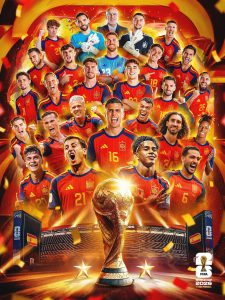
Spain deservedly lifted the trophy after navigating the biggest and most demanding World Cup football has ever produced.
But perhaps the greatest winner wasn’t Spain.
It was football itself.
The sport survived expansion.
It survived politics.
It survived conspiracy theories.
It survived celebrity overload.
It even survived a halftime concert.
Barely.
The 2026 World Cup reminded us that football is no longer merely the beautiful game.
It is now the beautiful spectacle.
Part sport.
Part business.
Part diplomacy.
Part streaming content.
Part reality television.
And entirely impossible to ignore.
Years from now we may forget the scorelines.
We may forget some goals.
We may even forget who won the Golden Ball.
But nobody will forget the World Cup where forty-eight nations came to play football, half the planet came to watch, politicians came to campaign, celebrities came to be seen, conspiracy theorists came fully prepared, FIFA discovered Broadway, and football somehow emerged, bruised, bewildered, richer than ever, and still gloriously capable of making billions of otherwise sensible adults scream at a television because someone was two centimetres offside.
If this is the future of the World Cup, then buckle up.
By 2030, don’t be surprised if VAR is sponsored by artificial intelligence, halftime features astronauts, and FIFA introduces “premium stoppage time.”
After all, in football, as in life, the bizarre has stopped being the exception.
It has become the format.
- Dike, Ph.D., is a public affairs analyst and writes from Canada.