By Olayinka Oyegbile
Maybe your country is only a place you make up in your own mind. Something you dream about and sing about. Maybe it’s not a place on the map at all, but just a story full of people you meet and places you visit ― Hugo Hamilton
(A review of David Jowitt’s From London to Jos: A British man’s 60-year journey to becoming Nigerian, Masobe Books, 2025)
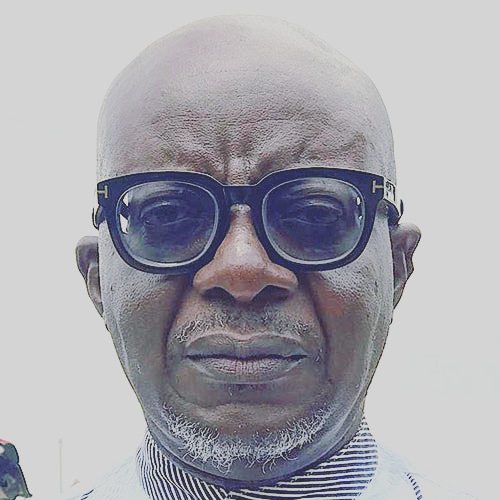
During my undergraduate years at Bayero University Kano, there was a “White Nigerian” on the campus. He was in the then Department of English and European Languages. Of course, we all knew he was a Briton but behind his back we called him the “White Nigerian”. He was often times dressed in Nigerian attires, sometimes from various parts of the country. When he was in trousers his top would not likely be the usual shirt worn by his folks but it would surely be something sewn out of Ankara (Atamfa), adire or something colourful. It was based on this that we nicknamed his the “White Nigerian”.
It was not only that, on a daily basis posted on his office door are new Hausa words or proverbs that many of those who are speakers of the language themselves didn’t know or were unfamiliar with. They were all part of his demonstration of deep love for the country called Nigeria! The “White Nigerian” was Prof David Jowitt, who died in August 2023, just a few months after his dream to become a Nigerian was realized in May 2023!
Although he never taught me as an undergraduate because his area of specialization was language while I love the literature aspect of it. Reading his recently published memoir has brought me close to him and make me realise that his love for Nigeria was not superficial. It was an organic love. But that it took him that long to get the citizenship is a demonstration of the fact that those who deserve somethings don’t get it as at when due. Although, as he himself explained he was at a time sitting on the horn of a dilemma because his country of origin does not allow citizens to have dual citizenship until not too long ago.
In Jowitt’s life one could read that passion and love for Nigeria. His coming to the country was not planned. But since his arrival to the country just three years after independence he fell in love and was determined to be a part of the teachers that would mould the youths of the emerging nation to the wonders and liberating power of education. And that he did for decades.
His first port of call was Ubulu-Uku in the present Delta State, at Anglican Grammar School. It was at a time the country was still newly independent and the young Jowitt decided to pitch his tent here. His time in the school was enlaced with joy and sadness but he was a young man determined to explore and know the people more than on the pages of newspapers even though Nigeria then had not begun to be in the news for the wrong reasons. He spent two years in Ubulu-Uku before moving back home but the move was still not satisfying he was still attracted to Nigeria and his tour of duty was not over.
Three years later (1966), he was back in Nigeria. This time at Onitsha where he got a job at the famous Dennis Memorial Grammar School, founded in 1925. This posting and the time of his arrival was to make him an eye witness of the civil war that was to breakout in the country one year hence. His experience in Onitsha which was one of the most contested cities in the war was memorable. It was there he witnessed the surge of Pentecostal prayers which was so strange to him that he had to confess that not even in his country did he witness the kinds of religious fervour and commitments that he encountered here!
His story about his escape from the war zone when it broke out and how he and two others had to be evacuated through Cameroun to Lagos for their onward journey to Britain is nerve raising. He left physically but had empathy for the war victims he had left behind in Onitsha (p149). One would have thought that scary experience was enough to kill his love of the country. For the time the war lasted he took a reprieve to Libya and was back almost as soon as the guns went silent. Such a love.
On his return to Nigeria, he moved around, especially in the north. The only parts of Nigeria that his odyssey did not cover (as a longtime resident) were the Southwest and the Niger Delta areas. He was in Okene, Pakshin, Kano and ended in Jos. His experiences in all the places of his sojourn are well detailed and he told the story with candour and fun memories that one is bound to agree with him that, “Nationality is not a biological endowment.” Many Nigerian politicians don’t have the love of the country they preside over as Jowitt did!
On the place of religion and the reality of life in Nigeria he asks, “If Nigeria is a deeply religious country, this disturbing question arises: Why is it that faith so often seems not to affect moral behaviour – in the management of public funds, for example? And conversely, why is it that a country like Britain, where faith has steadily been on the decline, continues to have much higher level of public probity? (p305). Look at the names and profiles of all public officials under trial by EFCC. Are they not people who profess faith ether as Christians or Muslims?
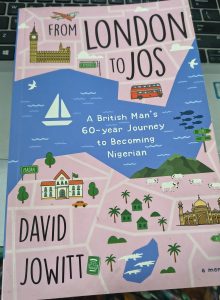
It is sad that Prof Jowitt who had all his life desired Nigerian nationality only got it in May 2023 and died in August of the same year! Very sad that death did not allow him to enjoy this opportunity in full. Not only that, his memoir too was published two years after his death. The joy of it all is that he told his story by himself and he did it engagingly well. The memoir is a delight to read.
However, the editor of the book blundered. On page 264 where Jowitt wrote briefly about the annulled June 12, 1993 election. The winner of the election was described as “the charismatic Mahmood Abiola”. NO. It was Moshood NOT Mahmood. Also, on page 265 ASUU became Academic Staff of Universities Union. NO. It is Academic Staff Union of Universities! I hope these blunders are corrected in a reprint. Despite these, the book is worth the efforts.
Rest well the White Nigerian.